


Stories of Strength
Updated: Jul 30
Ringing Her Own Bell: Sandy Cannupp’s Story
This article was written by a Queens University student as part of a community storytelling partnership.
Get to Know Sandy

Sandy is a native Charlottean who currently lives in Gaston County, North Carolina, with her husband of 15 years, their 4-year-old daughter, Lily, three dogs, and three chickens. In her free time, she enjoys helping at her daughter’s daycare, attending Bible study groups, going on jogs, and spending time with family and friends. At age 37, Sandy was diagnosed with stage IV metastatic breast cancer. Now 41 and thriving, she continues to inspire those around her with her resilience, positive outlook, and dedication to finding joy in each day. In October 2025, four years into her journey with stage IV breast cancer, Sandy shared her story—one marked by strength, hope, and an unwavering commitment to fostering inner happiness.
Path to a Diagnosis
Like many women with breast cancer, Sandy’s first hurdle was convincing her doctor to take her seriously. In early 2022, Sandy noticed something was wrong with her breast. She had swelling, a tumor large enough to feel, and dimpling on her skin similar to the texture of an orange peel.
When she brought these concerns to her doctor, her symptoms were brushed off and downplayed. Her doctor insisted that they were caused by a clogged milk duct even though Sandy hadn’t breastfed in over a year. The doctor said she was fine, and because she was only 37 at the time, she was told she’d have to wait a month for a mammogram. But Sandy knew she needed it sooner.
Without support from her doctor, Sandy had to advocate for herself. She called the office daily and kept sending messages in her health portal. When Novant couldn’t get her in for a mammogram, she told them to refer her to another office. “I was harassing them,” she says, and it worked. She got into Charlotte Radiology and they did a mammogram. The mammogram turned into an ultrasound. And then, they told her to come back in an hour for biopsies. Sandy was shocked, not entirely sure what to think other than “what??”.
A couple days later, Sandy’s biopsy results were posted in her health portal while she was at work. At the time, Sandy did administrative work at Carrington Place, a skilled nursing facility in Matthews.
“I was so scared,” she recalls feeling as she sat with the director of nursing and read the results. Sandy’s fears came true—she had cancer. But at the time, they didn’t know it was stage IV.
“I was so scared,” she recalls feeling as she sat with the director of nursing and read the results.
In June of 2022, Sandy was diagnosed with stage IV breast cancer after a series of scans revealed tumors in her right breast, liver, and lymph nodes.
She started chemotherapy right away and by October of 2022, Sandy showed no evidence of disease—her scans were clear.
In May of 2023, her health took a turn for the worse. Sandy knew something was wrong when she started having terrible headaches. “It was horrible, like going into labor. I would get up to go to the bathroom and I’d throw up,” she explains.
Days later, she found out that cancer was in her brain. “There were tumors all over my brain,” she says. “It looked like somebody took pepper and put it on my brain.” She immediately started full brain radiation and went through ten rounds.
“There were tumors all over my brain,” she says. “It looked like somebody took pepper and put it on my brain.”
Today, Sandy is coming up on three years with no evidence of disease. She manages her stage IV as a chronic illness with medication, routine scans, and healthy lifestyle habits.
Be your own advocate
“How did this happen so fast?” Sandy recalls asking her first oncologist. She was told that the tumors had probably been there for a while, but she couldn’t have known anything was wrong until her symptoms appeared. “They showed up really fast,” she says, stating that it took only one week for her symptoms to emerge.
Her doctor said this happens a lot— people under the age of 40 often have tumors that get overlooked because they can’t get a mammogram. That’s why she says it’s so important to be your own advocate.
Sandy has a family history of breast cancer on both her mom’s side and her dad’s side, but she doesn’t have the BRCA1 or BRCA2 gene mutation. Therefore, insurance wouldn’t have covered her mammograms unless it was medically necessary.
Sandy is a firm believer that the minimum age to have a mammogram should be lowered. As breast cancer cases increase, including those attributed to environmental factors, “you’d think they’d lower the age to like 20s,” Sandy states. “I have friends that are diagnosed in their 20s that don’t have the BRCA gene. It’s crazy.”
“you’d think they’d lower the age to like 20s,” Sandy states. “I have friends that are diagnosed in their 20s that don’t have the BRCA gene. It’s crazy.”
Finding Hope and Inner Peace
When Sandy first got diagnosed, she was in a really dark place. Her uncle and aunt had recently passed, her husband was travelling a lot for work, and she was working full time. “It was difficult,” she says about the beginning of her chemotherapy. “I wasn’t able to eat and I was throwing up all the time after treatment.”
“It was difficult,” she says about the beginning of her chemotherapy. “I wasn’t able to eat and I was throwing up all the time after treatment.”
Luckily, right before her daughter, Lily was born, she and her husband closed on a house right next to her cousins. So, while she was in treatment, they came by and offered a lot of support— cooking meals and helping take care of Lily. Even though Sandy didn’t have an appetite from the chemo, she appreciated it because she wasn’t able to cook or do anything for her family at that time.
In 2009, Sandy tragically lost her mom to mental health issues. “It’s been hard to not have my mom, and then I lost my grandma, my mom’s mom. We were super close. She was a breast cancer two time survivor and she passed from leukemia.”
Sandy has seen firsthand how much poor mental health can affect physical health—and vice versa— so she’s made it a priority to care for her own emotional well-being.
“I’ve changed a lot of my lifestyle— eating habits, praying more, going to church, working out— and I’ve seen that being in a good place, I don’t even have side effects from treatment anymore,” she explains. “I don’t get fatigued or anything. I can go for a jog after I’ve had my treatment— which is crazy, so there is proof to that. Being in a good mental state will help you physically.”
“I’ve changed a lot of my lifestyle— eating habits, praying more, going to church, working out— and I’ve seen that being in a good place, I don’t even have side effects from treatment anymore,”
It comes in waves
Throughout her journey, Sandy has gone to support groups and counseling to protect her mental health and cope. “It comes in waves,” she says.
“When I’ve lost friends, suddenly we all know that we’re gonna die one day. Is it from breast cancer, pneumonia, a car accident? We just don’t know... But at any point, my life can change and I really try not to focus on that.”
I’m hopeful
She believes that everyone should find something that gives them inner peace. For Sandy, prayer helps her have hope for the future. She doesn’t think everyone has to find peace in faith, but she’s found that praying, going to church, doing bible studies, and reading her bible has helped her a lot in dealing with her chronic illness. When she doesn’t feel hopeful, she finds ways to distract herself from her negative thoughts, like by running, praying, or talking to friends.
“I hear people tell me all the time, ‘Gosh you’re so positive all the time. How do you do it and how do you stay strong?’” she says. “Well, my faith, my family, my friends, talking about it with other people that can relate to my situation, that helps. And then also just taking a break, you know? I don’t always want to talk about it.
“I hear people tell me all the time, ‘Gosh you’re so positive all the time. How do you do it and how do you stay strong?’” she says.
Connecting with Community
Sandy’s experience with stage IV breast cancer has “really humbled me,” she says. “That’s maybe the silver lining— the cancer has forced me to lean on other people when I wasn’t doing that before. It shows me how good people can be.”
“That’s maybe the silver lining— the cancer has forced me to lean on other people when I wasn’t doing that before. It shows me how good people can be.”
Her faith has always come first, but her faith says that you can’t do things alone. That’s why leaning on your community is so important— “it’s easy to get into a dark place if you’re trying to figure out all of what’s going on by yourself,” she states.
She found support from organizations like Go Jen Go, Nothing Pink, and Carolina Breast Friends. When she was first diagnosed, The Pink House helped her get set up with support groups, counseling, and got her a wig. “When I went bald, it was just so emotional, but I felt so excited when they gave me a wig. It was straight hair too, and it was kinda sexy, and I was like ‘oh my gosh I have this confidence and I love that’,” she explains.
The Pink House helped connect Sandy to other thrivers. She says that being around other people that truly understand what she’s going through has helped her tremendously with her mental health.
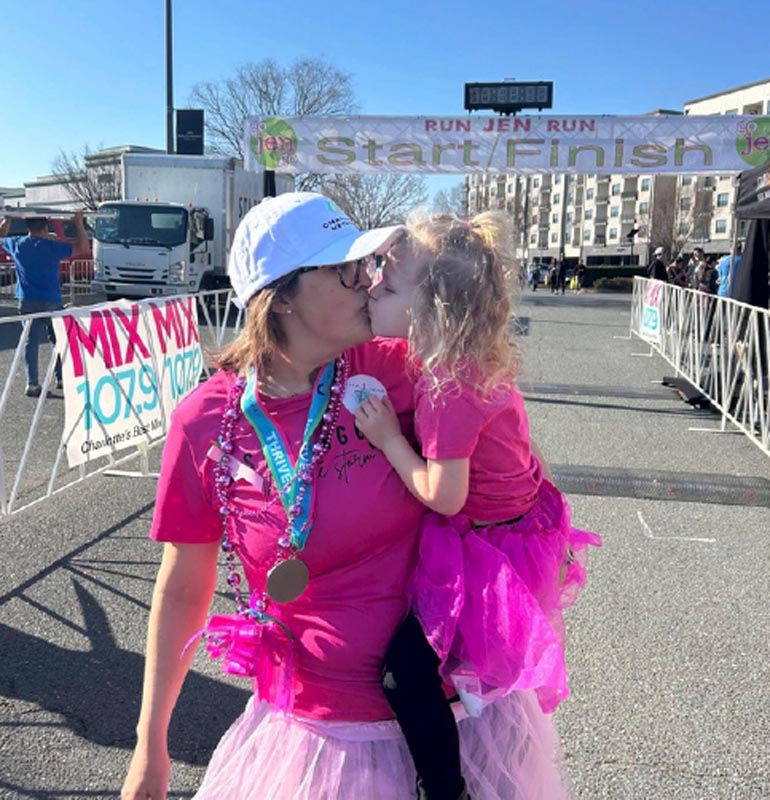
As a mom to a now 4-year-old, Sandy has been able to connect with other thriver moms and ask for advice about how to answer her daughter’s questions. “Last year she was 3, and I was like ‘Oh Mommy’s got cancer bugs’ and this year she’s almost 5 and she is way more in tune. She has way more questions, and it’s nice to have those people that I can talk to about how to deliver this to her without stressing her out,” Sandy says.

Breaking the Stigma of Stage IV
Sandy is four years into her journey with stage IV breast cancer. By sharing her story, Sandy wants to bring awareness to metastatic breast cancer and challenge the stigma surrounding it.
Many people don’t know what it means to be a “thriver,” she says. “Years ago, you were diagnosed with stage IV and everybody’s like ‘oh my gosh she’s going to die in a year or two.’” Sandy is technically considered to have a terminal disease, but she doesn’t like to say that because she’s thriving. “I like people to see how well I’m doing.”

Sandy’s treatment doesn’t end once she leaves the hospital. “With stage IV, we don’t get to ring the bell,” she says. “But I ring my own bell after every positive treatment or clear scan.”
“I want people to see how I’m thriving now and how far I’ve come. And I hope I can inspire others and lift them up too.”
“I want people to see how I’m thriving now and how far I’ve come. And I hope I can inspire others and lift them up too.”
Download the original article↓

